Kervano Pest SpecialistsKervano Pest Specialists

Basement Flea and Mite Remediation Boston

Subterranean parasite populations in Boston brownstones and single-family homes frequently originate from wild animal entry rather than domestic pets. Field mice, rats, and urban squirrels nesting beneath floorboards…
Get My Free Estimate →(857) 737-8398
Basement Flea and Mite Remediation in Boston, MA
Quick answer
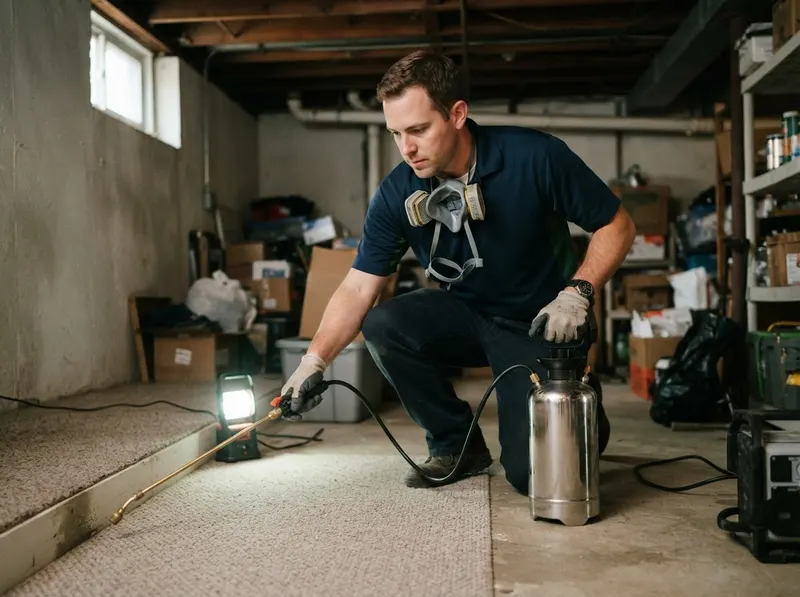
  • What is included: Deep HEPA vacuum extraction of masonry floor cracks, targeted low-toxicity insect growth regulator application, and subterranean perimeter host harbourage inspection.
  • Turnaround time: On-site physical remediation requires 2 to 4 hours, followed by a mandatory 2 to 3 hour re-entry wait interval while liquid applications dry completely.
  • Service cost: Diagnostic basement treatments start at a $200 baseline fee, scaling between $275 and $550 depending on foundation square footage and floor substrate material.
  • What is removed: Target populations include cat fleas (Ctenocephalides felis), rodent-borne bird and rodent mites (Ornithonyssus and Liponyssoides species), and lingering larval stages.
  • Contact method: Remediation is arranged directly by calling (857) 737-8398 to schedule an on-site structural assessment of the foundation footprint.

Subterranean parasite populations in Boston brownstones and single-family homes frequently originate from wild animal entry rather than domestic pets. Field mice, rats, and urban squirrels nesting beneath floorboards or inside fieldstone voids bring secondary ectoparasites directly into damp lower levels. In older masonry basements across Jamaica Plain, Dorchester, and the North End, relative humidity levels above 50 percent combined with temperatures over 70 degrees Fahrenheit create ideal microclimates for flea larvae and rodent mites to persist in dirt subfloors, concrete hairline fractures, and mortar joints.

Over-the-counter total release foggers, commonly called bug bombs, fail because their upward propellant cannot penetrate downward into the substrate crevices where pupae and eggs reside. Basement flea and mite remediation uses targeted surface applications containing pyrethroid alternatives paired with an insect growth regulator like pyriproxyfen, which biochemically arrests the chitin synthesis of maturing nymphs. In porous stone foundations common in Beacon Hill and Back Bay, treatments integrate structural moisture evaluation, since desiccation dusts like amorphous silica gel work synergistically with physical humidity reduction to disrupt the waxy epicuticle of crawlspace mites.

When choosing an intervention, property owners often weigh a whole-house broadcast spray against targeted basement remediation. Whole-house spraying introduces unnecessary chemical volume to occupied second and third floors when the actual vector reservoir remains confined to the foundation. Choosing targeted basement remediation isolates the treatment chemistry directly to the lower masonry envelope, though it requires homeowners to simultaneously address host rodent exclusions along sill plates to ensure long-term control. Kervano Pest Specialists conducts physical barrier checks alongside targeted applications to break the environmental reproduction loop permanently.

Basement Flea and Mite Remediation cost in Boston

Unfinished Basement up to 600 sq ft$200 - $325
Standard Masonry Basement (600 - 1,200 sq ft)$325 - $450
Large or Multi-Room Fieldstone Basement (1,200+ sq ft)$450 - $650
Secondary Sub-Slab Rodent Host Exclusion Add-on$200, $350

Every job gets a firm, written price after a free on-site visit.

Common questions

Why do flea and mite infestations start in Boston basements without pets?
Basement infestations without domestic pets occur when urban wildlife such as Norway rats or feral mice nest inside rubble foundation walls, abandoning their ectoparasites once host populations shift or perish.
What preparations are required before basement flea treatment in Boston?
Homeowners must clear direct floor access by raising stored cardboard boxes 12 inches off the ground, sweeping loose perimeter debris, and keeping domestic pets completely off lower levels during the service.
How long must residents stay out of a Boston basement after mite remediation?
Occupants and pets must remain out of the basement space for 2 to 4 hours post-application until all liquid residual barriers and desiccation dusts have fully dried and settled.
Does basement remediation address rodent mites inside wall cavities?
Yes, technicians inject precision desiccation dust into wall plate voids and accessible joist pockets where bird and rodent mites travel along plumbing conduits and utility chases.
Are the chemical treatments used in Boston homes safe around children and companion animals?
The applied insect growth regulators and botanical or synthetic pyrethroids bind tightly to foundation surfaces upon drying, presenting negligible transfer risk to children and pets when established re-entry windows are observed.
Helpful resources

Trusted references & local links

USA.gov, government & consumer helpBetter Business BureauFTC Consumer AdviceU.S. Small Business AdministrationReady.govU.S. EPAENERGY STARU.S. Dept. of EnergyConsumer.govU.S. Census BureauGoogle Maps, Boston, MA

Get started today

Tell us about your basement flea and mite remediation job in Boston and we'll send a clear, written quote, usually the same day.

Get your free PEST CONTROL SEVICE quote, Boston

We only use your ZIP to check availability, no spam.