In dense Boston multi-family neighborhoods like the North End, Beacon Hill, and South Boston, bed bugs migrate easily through shared floor joists, conduit paths, and party walls. Historic buildings with horsehair…
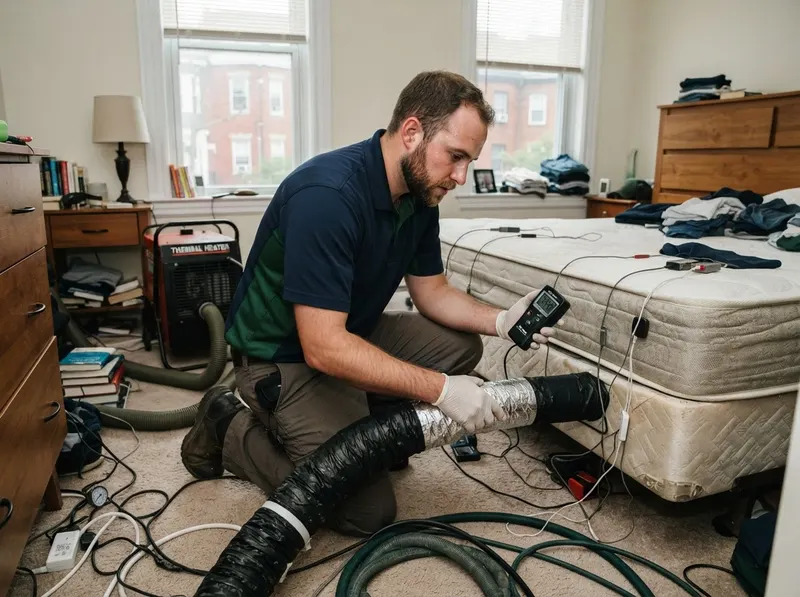
In dense Boston multi-family neighborhoods like the North End, Beacon Hill, and South Boston, bed bugs migrate easily through shared floor joists, conduit paths, and party walls. Historic buildings with horsehair plaster, double-brick mass walls, and heart-pine subfloors present complex hiding surfaces that liquid contact sprays cannot penetrate. Bed bug thermal remediation bypasses the mechanical limits of surface insecticides by converting the target living space into a contained convection chamber. Industrial heaters introduce clean, dry heat, while directional air movers circulate the air column to ensure heat penetrates dense mattresses, deep baseboard cracks, and framing void spaces. Target lethal heat (122°F) eliminates adults, nymphs, and eggs by causing systemic cellular dehydration and protein coagulation within 90 minutes of continuous thermal exposure.
Selecting structural thermal treatment instead of repetitive chemical applications depends on occupant density, structural material, and infestation severity. If an apartment in an Allston triple-decker or a Back Bay brownstone contains heavy clutter or multi-layer historic moldings, thermal remediation is the optimal selection because air currents reach internal micro-harborages without requiring total textile disposal. Conversely, if localized clutter cannot be prepared or if heat-sensitive equipment cannot be relocated, traditional low-toxicity Integrated Pest Management (IPM) spot treatments serve as the logistical alternative, though chemical programs require 3 to 4 separate visits spaced 14 days apart to target subsequent hatch cycles. The primary operational trade-off of whole-structure thermal remediation is extensive pre-service preparation: occupants must temporarily remove heat-vulnerable items such as aerosol cans, vinyl records, candles, oil paintings, prescription medications, and household pets before the heating cycle begins.
Kervano Pest Specialists conducts thermal protocols using calibrated wireless temperature sensors placed in the coolest zones of the target space, underneath center bed frames, beneath floor runners, and inside external wall cavities. In residential architectures across Jamaica Plain, Roxbury, Charlestown, and Brighton, historic drafts can cause uneven thermal gradients. Operators actively monitor these zones remotely, rotating furniture and repositioning air blowers during the treatment window to guarantee core temperatures hold above the thermal death point without exceeding 138°F, which protects interior fixtures, electronics, and plumbing gaskets. The remediation finishes with an infrared camera inspection to verify that zero heat sinks remain below target survival thresholds.
Every job gets a firm, written price after a free on-site visit.
Tell us about your bed bug thermal remediation job in Boston and we'll send a clear, written quote, usually the same day.
 Kervano Pest Specialists