Residential rodent exclusion stops ongoing home invasions by addressing the architectural breaches common to Suffolk County housing stock. In historic fieldstone and brick rubble foundations across Beacon Hill, the…
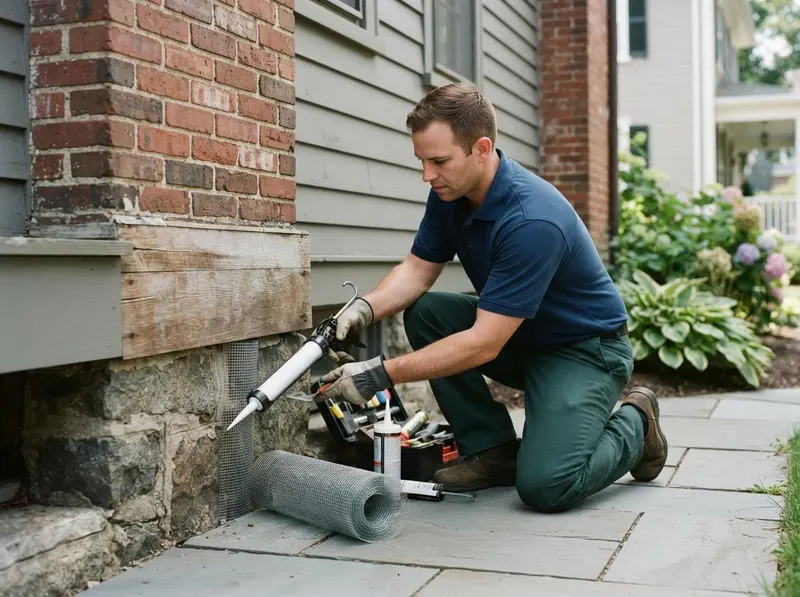
Residential rodent exclusion stops ongoing home invasions by addressing the architectural breaches common to Suffolk County housing stock. In historic fieldstone and brick rubble foundations across Beacon Hill, the North End, and Charlestown, mortar leaches out over decades, leaving subterranean gaps exceeding one-half inch. Norway rats leverage these voids alongside sewer laterals, while house mice exploit gaps as narrow as one-quarter inch around gas risers, radiator lines, and deteriorated sill plates in Dorchester triple-deckers and South Boston multi-family properties. Trapping programs reduce existing populations indoors, but without physical exclusion, structural drafts and food aromas continuously pull new colonies from neighboring alleyways and MBTA rail corridors. The mechanical exclusion method substitutes temporary poison baits with 19-gauge galvanized hardware cloth, silicone-embedded copper mesh, and elastomeric sealants that rodents cannot chew through.
Selecting permanent structural exclusion over recurring chemical bait programs eliminates the risk of indoor rodent expiration inside drywall bays, which prevents persistent carcass odors and secondary insect infestations in living areas. Chemical-free physical barriers also remove non-target toxicity risks for household pets and young children. For single-family residences in Jamaica Plain, West Roxbury, and historic row houses in Back Bay, entry-point engineering covers foundation air vents, bulkheads, masonry seams, and utility entry penetrations. If a structure exhibits active burrows beneath granite slab steps or voids around subterranean stone masonry, mechanical trenching and wire-barrier installation protect the sub-grade envelope.
Step-by-step exclusion sequence:
1. Foundation and roofline mapping: Technicians identify every gap wider than one-quarter inch from grade to soffit line, logging chimney flashings, crawlspace penetrations, and utility conduits.
2. Barrier material installation: Technicians pack openings with woven copper gauze, anchor galvanized steel hardware cloth, and top-seal gaps with hydraulic cement or rodent-proof elastomeric foam.
3. Utility line and pipe escorting: High-heat conduits, plumbing waste lines, and HVAC copper lines are secured using metal escutcheon plates and high-density backer rod.
4. Interior interior chamber clearance: Active populations trapped inside the envelope are captured via mechanical snap arrays within 7 to 14 days, verifying zero sound or movement in ceiling voids.
Every job gets a firm, written price after a free on-site visit.
Tell us about your residential rodent exclusion job in Boston and we'll send a clear, written quote, usually the same day.
 Kervano Pest Specialists